
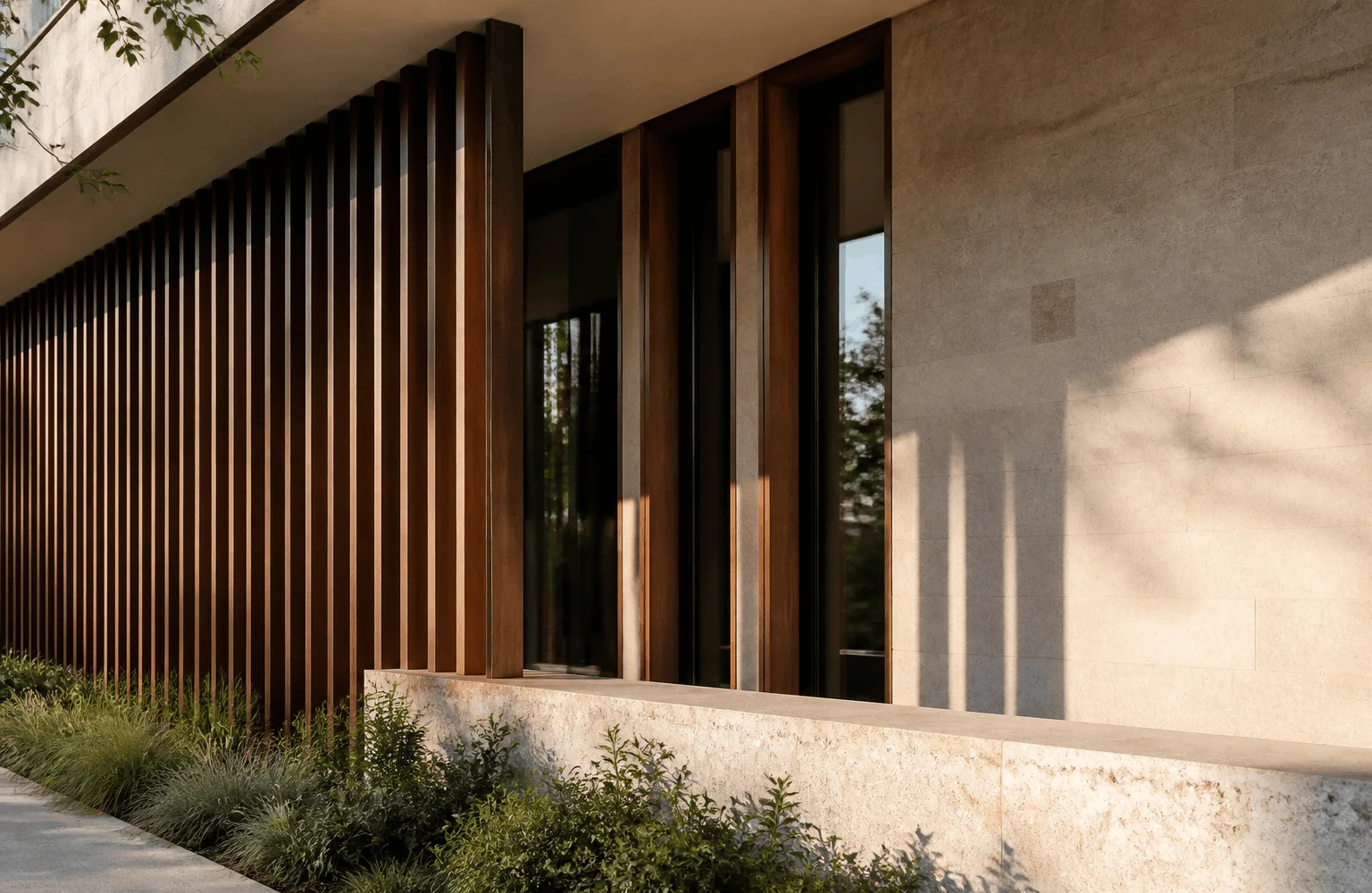
Sustainable design beyond a choice
Sustainable architecture becomes meaningful when it informs every decision from the first sketch to the final detail. Orientation, daylight, ventilation, and low-carbon materials can reduce energy demand while creating greater comfort.
The goal is not to add technology to an ordinary design, but to shape a coordinated system that performs responsibly throughout the building's life.
Material choice is also a form of storytelling. Stone, timber, brick, metal, and plaster each carry a different relationship with time, maintenance, touch, and climate. The best palette is rarely the largest one. It is the palette that can be understood, repaired, and repeated with care. A restrained set of materials gives the project a clear identity while daylight, planting, and furniture complete the experience.
Good performance should be felt before it is measured. Comfortable temperature, quiet rooms, useful shade, and balanced daylight make a building easier to inhabit. Passive decisions such as orientation, openings, thermal mass, and cross ventilation often have more lasting value than complicated systems added at the end. Technology should support a calm and legible environment instead of becoming the visual subject.
The design process becomes stronger when it includes honest constraints. Budget, construction skill, local supply, future adaptation, and cleaning are part of the brief. Testing a detail at full scale, speaking with craftspeople, and reviewing maintenance can reveal more than another round of polished images. These practical conversations protect the idea by giving it a credible path into the world.
Context gives a project its responsibility. A new intervention should read the climate, history, neighboring buildings, street patterns, and social habits around it. That does not require imitation. It requires a precise response: opening a view, protecting a threshold, framing a tree, or making a shared edge welcoming. Contemporary design can be distinctive without becoming detached from its place.
The most durable projects leave room for change. Families grow, businesses evolve, furniture moves, and unexpected uses appear. Flexible rooms, accessible services, generous storage, and details that can be repaired make adaptation possible without erasing the original intention. Beauty and usefulness meet when a project remains generous after the photograph and the first day of occupation have passed.
A strong architectural idea begins with observation. The designer studies how people arrive, pause, work, rest, and move through a place. That attention turns a brief into a sequence of useful decisions: where light should enter, where privacy should increase, and where a material should be allowed to show its age. For Sustainable construction meets innovation, every drawing is a question about daily life rather than an isolated image.
Material choice is also a form of storytelling. Stone, timber, brick, metal, and plaster each carry a different relationship with time, maintenance, touch, and climate. The best palette is rarely the largest one. It is the palette that can be understood, repaired, and repeated with care. A restrained set of materials gives the project a clear identity while daylight, planting, and furniture complete the experience.
Good performance should be felt before it is measured. Comfortable temperature, quiet rooms, useful shade, and balanced daylight make a building easier to inhabit. Passive decisions such as orientation, openings, thermal mass, and cross ventilation often have more lasting value than complicated systems added at the end. Technology should support a calm and legible environment instead of becoming the visual subject.
The design process becomes stronger when it includes honest constraints. Budget, construction skill, local supply, future adaptation, and cleaning are part of the brief. Testing a detail at full scale, speaking with craftspeople, and reviewing maintenance can reveal more than another round of polished images. These practical conversations protect the idea by giving it a credible path into the world.
Context gives a project its responsibility. A new intervention should read the climate, history, neighboring buildings, street patterns, and social habits around it. That does not require imitation. It requires a precise response: opening a view, protecting a threshold, framing a tree, or making a shared edge welcoming. Contemporary design can be distinctive without becoming detached from its place.
The most durable projects leave room for change. Families grow, businesses evolve, furniture moves, and unexpected uses appear. Flexible rooms, accessible services, generous storage, and details that can be repaired make adaptation possible without erasing the original intention. Beauty and usefulness meet when a project remains generous after the photograph and the first day of occupation have passed.
A strong architectural idea begins with observation. The designer studies how people arrive, pause, work, rest, and move through a place. That attention turns a brief into a sequence of useful decisions: where light should enter, where privacy should increase, and where a material should be allowed to show its age. For Sustainable construction meets innovation, every drawing is a question about daily life rather than an isolated image.
Material choice is also a form of storytelling. Stone, timber, brick, metal, and plaster each carry a different relationship with time, maintenance, touch, and climate. The best palette is rarely the largest one. It is the palette that can be understood, repaired, and repeated with care. A restrained set of materials gives the project a clear identity while daylight, planting, and furniture complete the experience.
Good performance should be felt before it is measured. Comfortable temperature, quiet rooms, useful shade, and balanced daylight make a building easier to inhabit. Passive decisions such as orientation, openings, thermal mass, and cross ventilation often have more lasting value than complicated systems added at the end. Technology should support a calm and legible environment instead of becoming the visual subject.
The design process becomes stronger when it includes honest constraints. Budget, construction skill, local supply, future adaptation, and cleaning are part of the brief. Testing a detail at full scale, speaking with craftspeople, and reviewing maintenance can reveal more than another round of polished images. These practical conversations protect the idea by giving it a credible path into the world.
Context gives a project its responsibility. A new intervention should read the climate, history, neighboring buildings, street patterns, and social habits around it. That does not require imitation. It requires a precise response: opening a view, protecting a threshold, framing a tree, or making a shared edge welcoming. Contemporary design can be distinctive without becoming detached from its place.
Real innovation happens when beauty, performance, and respect for resources meet in one architectural decision.
Leave a reply
Your email is used only for moderation and is never published.
Comments
A thoughtful and inspiring article.